


There is nothing particularly new about jollof rice.
There is nothing new about shawarma either.
Yet Ibigbemi Oloruntobi has built Item7Go around these familiar foods into a fast-growing Nigerian quick-service restaurant business with more than 45 outlets.
Perhaps that is precisely what makes the story worth studying.
Oloruntobi graduated from the University of Ilorin with a degree in Physics in 2011. A year later, Item7Go began as a small food business around the university, serving students who wanted meals that were affordable, filling and quick.
Fourteen years later, the business has moved far beyond its university beginnings. Item7Go now operates across multiple Nigerian cities, including Ilorin, Ibadan, Lagos and, most recently, Abuja. A September 2026 report on its Abuja opening puts the chain at more than 45 outlets nationwide.
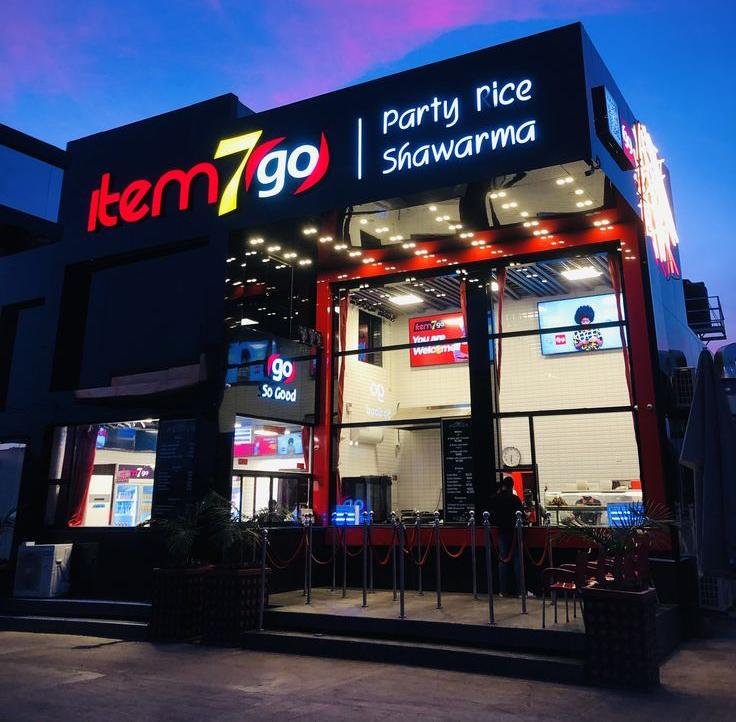
But the more interesting story isn’t how many branches Item7Go has opened.
It’s what the business appears to have understood along the way.
You Don’t Always Need to Invent Something New
Entrepreneurship is often presented as the search for the next revolutionary idea.
Item7Go suggests another route.
Rice already had a market. Nigerians already understood party jollof. Students already needed affordable meals.
The opportunity wasn’t necessarily to create new demand. It was to serve existing demand exceptionally well.
Item7Go built around a straightforward proposition: familiar food, accessible pricing and convenience. BusinessDay describes the attraction of the brand in similarly simple terms: good food, fair prices and quick service.
There is a lesson here for founders constantly searching for an idea nobody has ever seen before: the opportunity may not lie in creating a new product, but in finding a better way to package, deliver and build a business around something people already want.
Simplicity Can Be a Strategy
Look at the Item7Go proposition and there is another interesting choice: focus.
Rather than trying to become everything to everybody, the brand became strongly associated with a relatively narrow range of familiar foods, particularly its rice combinations and shawarma.
That matters.
- A focused offering can make:
- purchasing easier to manage;
- preparation more consistent;
- staff training more straightforward;
customer expectations clearer.
And as a business adds locations, repeatability becomes increasingly important.
We cannot say from publicly available information exactly how Item7Go standardises its kitchens or what its unit economics look like. The company has not publicly disclosed detailed financial or operational data.
But its expansion demonstrates something founders often discover too late:
Complexity is expensive to scale.
Before adding more products, more services and more locations, it is worth asking whether the thing you already sell can be delivered repeatedly and reliably.
Technology Should Solve a Real Problem
Item7Go also hasn’t added technology simply to say it has an app.
Its ordering system solves a very ordinary problem: waiting.
Customers can order ahead through the Item7Go app or web app, choose a pickup location and collect when the food is ready. The company describes the proposition simply as “Ready on Arrival.”
That is what useful business technology often looks like: less friction between the customer and the thing they want.
For a smaller business, the equivalent doesn’t necessarily have to be an expensive custom app. It might be:
- a good website;
- a WhatsApp ordering system;
- automated payments;
- a better inventory process.
The question is the same:
Where is the friction, and what can remove it?
Start With One Market. Don’t Assume It Is Your Final Market.
Item7Go’s beginnings around the University of Ilorin are also instructive.
Students were an obvious first market for an affordable, quick meal. But the business did not remain a campus food stall.
It expanded into the wider city and eventually into other major markets.
Today, people who may never have heard of the original university outlet know the Item7Go brand.
That progression matters because founders sometimes confuse their first customer with their only possible customer.
Your first market can teach you how the business works.
It doesn’t necessarily define how large the business can become.
Standardise Before You Scale
And perhaps this is the biggest lesson in the Item7Go story.
Opening another branch is not really the difficult part of expansion. Reproducing what made the first one work is. That requires systems.
And perhaps this is where Oloruntobi’s Physics background provides an interesting metaphor, even if we shouldn’t claim it caused his business approach.
Physics trains you to think about systems, variables, cause and effect, and repeatable outcomes. A scalable business requires much the same discipline. The founder eventually has to turn what they know intuitively into processes that other people can understand, follow and reproduce.
A recipe has to become a consistent process. A particular way of serving customers has to become part of staff training. An ordering method can be supported by technology, while the practices that make one successful outlet work have to be structured well enough to be replicated across others.
That is how a business becomes less dependent on the person who started it and more capable of growing beyond them.
The Bigger Lesson
Item7Go did not invent rice, takeaway food or fast food. What it has done is take something Nigerians already understand and build an increasingly sophisticated business around delivering it consistently.
That may be the more useful entrepreneurship lesson in the story. Building a successful business does not always require creating something the market has never seen before. Sometimes, the opportunity lies in taking an existing product, understanding what customers value about it and finding a better way to deliver it.
We spend a lot of time looking for extraordinary ideas, but some of the strongest business opportunities can be found in ordinary products and familiar problems. The difference often comes from how well a founder understands the market, simplifies the offering, removes friction and builds systems that allow the business to repeat what works.
For founders, that is perhaps the most important takeaway from Item7Go: you do not always have to reinvent the product. Sometimes, you need to reinvent the way the business works.
The Brief Network: Inspiring Stories and Empowering Lessons.